
When we think of endangered species, we tend to think about exotic, faraway lands, but right here in Manitoba the burrowing owl population has declined over 96% since 1987, and one organization is working to change that.
Alex Froese, Founder and Executive Director of the Manitoba Burrowing Owl Recovery Program (MBORP) is a wildlife biologist who studied Manitoba wildlife in university, and now works tirelessly to educate and bring awareness to the endangered burrowing owl. She is assisted by Bindi, a full-grown burrowing owl, and an ambassador for the cause.
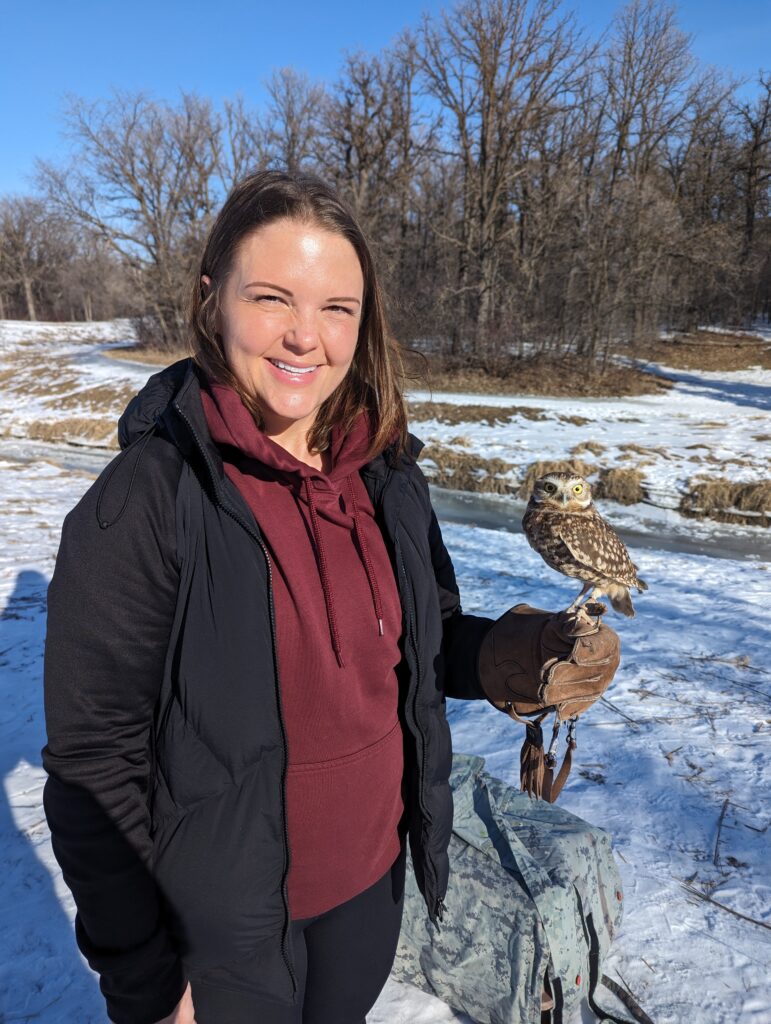
“I wanted to mix my love of endangered species work with owl work, and luckily (but unfortunately), we have an endangered owl here in the province that really needed a champion and a program to get going,” says Froese. “Without conservation and management, burrowing owls won’t be able to stick around; they’re conservation dependent.”
Froese started MBORP in 2013, and although there is no single factor responsible for the decline of burrowing owls and other grassland species, the major factor for burrowing owls is loss of habitat; changing grasslands to other land uses, such as housing, roads, and modern agriculture. Burrowing owls don’t build their own nests, they rely on other animals like foxes, ground squirrels, or gophers.
“If you change these grasslands to something else, any of the species that rely on that grass are not going to be able to flourish. In a lot of my presentations and outreach, I talk about how biodiversity is so important,” says Froese. “If you get rid of [grasslands], the species that live there can’t survive. If you remove something from an environment, no matter how small it may seem, it has a ripple effect on the whole ecosystem.”
While MBORP has received support from The Winnipeg Foundation, among others, the organization has seen a decline in public funding during the past five years. This decline has limited Froese’s capacity to do this work, but as the sole employee of the Manitoba Burrowing Owl Recovery Program, she plans community events and last year alone brought Bindi the owl to over 35 school presentations in 2023.
“We prioritize education events in southwestern Manitoban communities, because those are the people that are likely going to see a burrowing owl, since their range is only in southwestern Manitoba at this point in time.”
If someone discovers an owl on their property, the landowner can contact the program by calling 204-807-HOOT, and MBORP will have a conversation with that landowner, and they can come up with a plan together. They can set up a camera to monitor what’s going on at the burrow and educate folks about best practices to ensure the survival and thriving of the species.
While the 96% population decline is staggering, there has been some good news in the last few years. “In a decade with our program, we’re actually seeing wild owls coming back to Manitoba,” says Froese. “It’s so gratifying. During 2019 through 2023, those field seasons and breeding seasons we’ve seen huge improvements and so many owls coming back in family groups.”
Every year the organization does roadside surveys and surveys on southern properties. Recently, they have also been working with landowners who are open to artificial nest burrows, which seem to appeal to the returning owls.
“Grasslands are one of the most in-peril ecosystems in the world, and it’s in our backyard. I think a lot of people think about endangered ecosystems or species as something that’s not here; we think about the rainforest or the Great Barrier Reef, and those things are important, but they’re so far away,” says Froese. “When you can connect people to something that is right here, right in our backyard, it hits a little differently. It’s real.”
To see more photos of Bindi, follow them on Instagram @kokoandbindi or visit their organization website mborp.ca