

Gord Downie and Chanie Wejack Fund
Gord Downie and Chanie Wejack Fund
Legacy Schools Program Teaches Cultural Understanding
By: Kevin Rollason
Running away from a residential school, hundreds of kilometres from his family, all 12-year-old Chanie Wenjack wanted to do was go home.
Chanie never did finish his journey—he died of exposure and starvation far short of his goal—but now Winnipeg children and youth, along with their teachers, are joining him on a path of reconciliation both inside and outside the classroom supported by Winnipeg Foundation.
The Gord Downie and Chanie Wenjack Fund (DWF) is inspired by both Chanie’s story, and a call by Downie, before his death in 2017, for everyone in Canada to improve Indigenous-non-Indigenous relations. Downie was the lead singer and songwriter for the iconic Canadian rock band The Tragically Hip.
The DWF, through its Legacy Schools Program, is helping teach cultural understanding to children from day care to high school in order to bring reconciliation between Indigenous and non-Indigenous peoples. Currently, the Legacy Schools Program, in its ninth year of operation, has about 300 people in Winnipeg, who the DWF calls educators, inside 209 schools teaching 7,425 students. Across the country, the program reaches about 250,000 students with more than 10,000 educators in 7,500 schools. Besides schools, it also includes Girl Guides, Scouts and other organizations supporting youth and education.
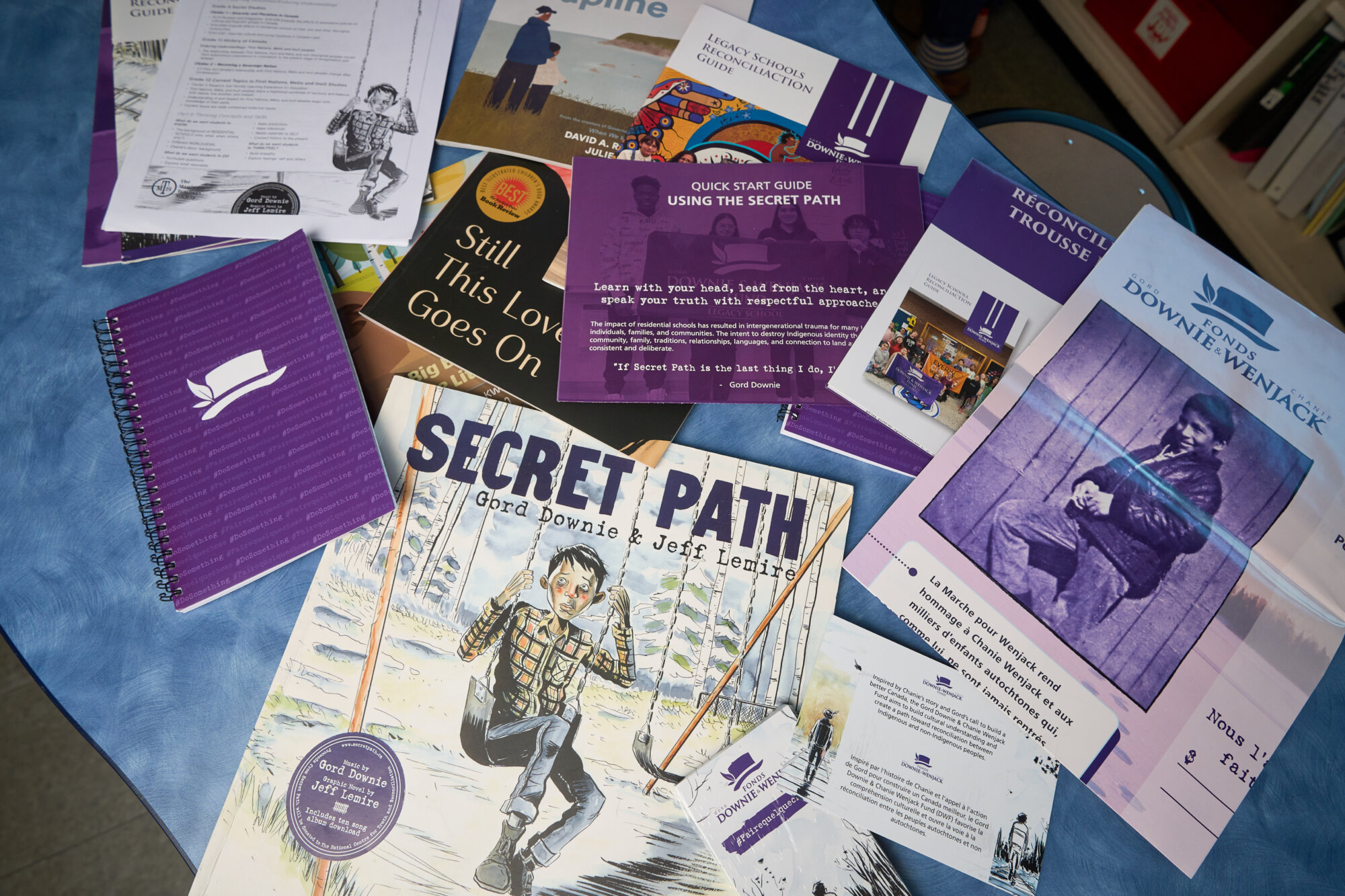
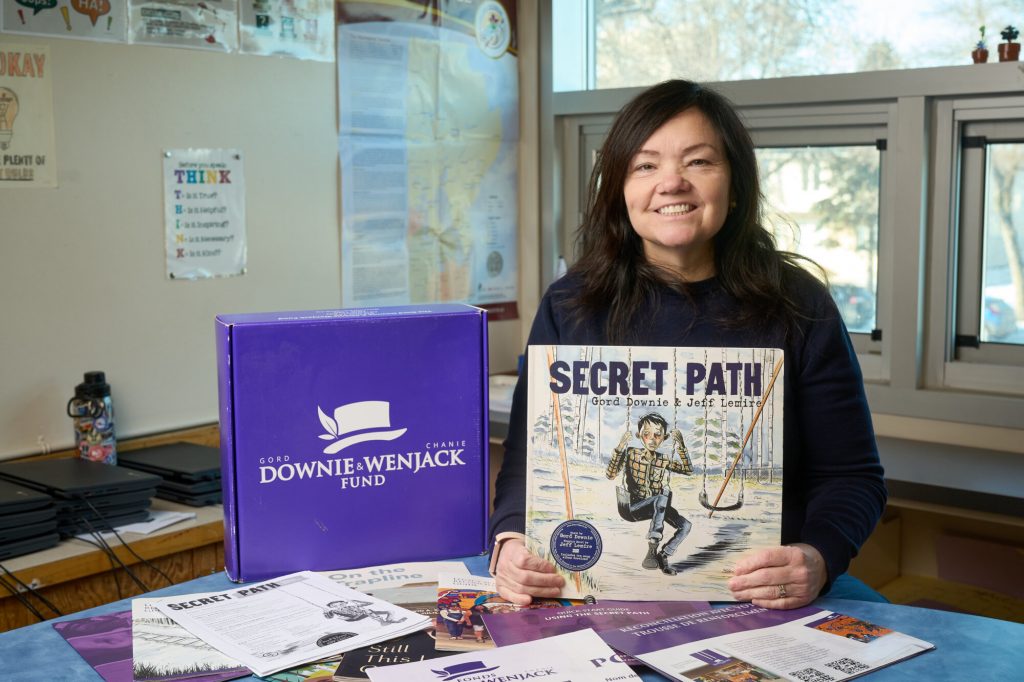
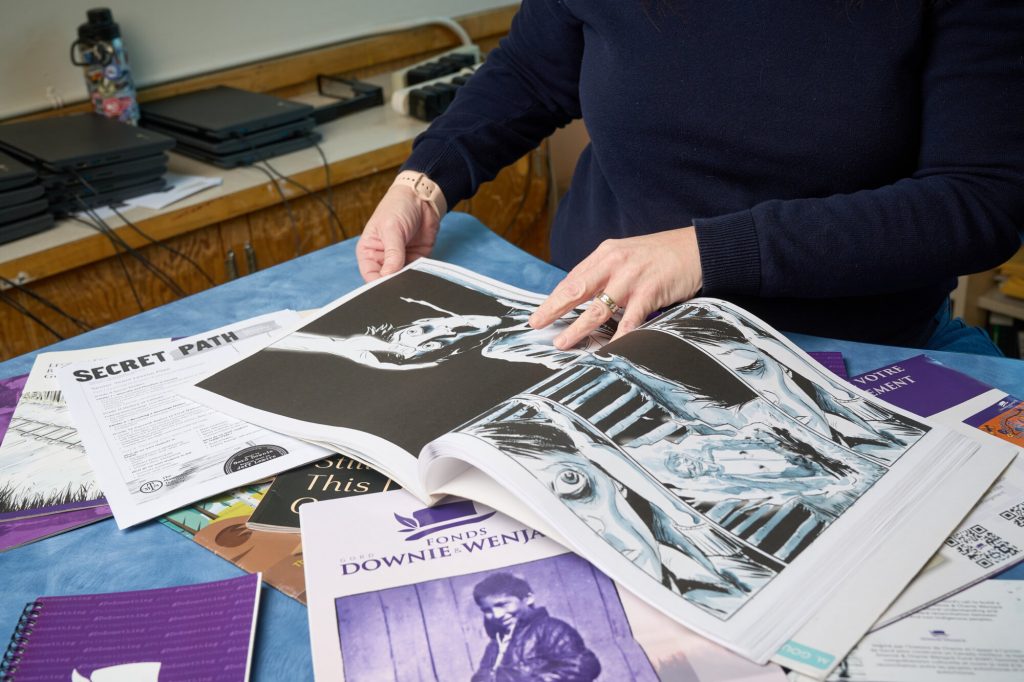
The program provides educators with a free kit containing tools and resources they can use to incorporate the teaching of Indigenous culture, emphasizing its richness and strength, into all subject areas. The kits include age and grade-appropriate lessons, activity guides and online learning. It also includes a copy of Secret Path, a graphic novel detailing Chanie’s story.
Michelle Gougeon is one of the Winnipeg educators. A Grade 7 teacher at Collège Churchill High School, in Winnipeg School Division, she has been part of the DWF program for about five years. “As a social studies teacher, I really do try to incorporate in a lot of Indigenous perspective,” Gougeon said. “You don’t just do it once a week. I try to be seamless in my Indigenous inclusion. My students have come to learn there is just a natural expectation and that it is a natural part of my day-to-day teaching.”
Gougeon said the program, which is updated for free annually, offers help for teachers who may be hesitant and worried about teaching the subject of reconciliation. “It’s not that I go and look for some Indigenous stuff that I can throw in,” she said. “It’s rather than I can look for Indigenous and then consider how my curriculum can bend around it. It is especially good for teachers who maybe feel intimidated by this work or are not feeling as natural or comfortable with this work.”
Chanie was only nine when he was sent to a residential school in Kenora, more than 600 kilometres away from his family. Three years later, Chanie and nine other students ran away with all but him found within 24 hours. Chanie was found a week later. His death sparked the country’s first inquest into the treatment of Indigenous children at residential schools. Downie learned about Chanie’s story and in the last year of his life worked with the Wenjack family to produce an album, film, and graphic novel about him.
Gougeon said her students have gone outside the classroom to do a community walk in honour of Chanie. She said they have also tied ribbons on the school’s fence to honour and remember missing and murdered Indigenous women, girls and two-spirit people on May 5. They’re not alone.
Students at Gonzaga Middle School created and painted a 40-foot mural along the front of a shipping container in their school yard. Institut collégial Vincent Massey Collegiate students went on a walk in honour of both Chanie and Downie led by the school’s drummer.
Carpathia School Grade 5 and 6 students, after learning about Chanie and residential schools, walked to the site of the Assiniboia Residential School on Academy Road in Winnipeg. There they saw a memorial consisting of paving stones carved with the names of more than 1,000 students who went to the school as well as 28 markers with the names of the 83 Indigenous communities they came from.
Sarah Midanik, the DWF’s president and CEO, has been with the organization since the beginning. “In our very earliest days, I remember going to Winnipeg,” she said. “We have a relationship with the National Centre for Truth and Reconciliation so we’ve had Legacy Schools in Winnipeg from the very beginning.” Midanik said they try to make their programming as accessible as possible to support core curricular learning objectives across all provinces and territories.
“I hate to say ‘choose your own adventure,’” said Midanik, “but we really try and support educators where they’re at, including something to help support them in math and sciences. “We just really want to help educators and support them so that there isn’t a fear, so they aren’t afraid to teach the true history of this country.”
The Foundation has provided $20,000 in funding from its Community Grant program to the DWF. The organization is hoping it will help it increase participation in its Legacy Schools Program in Winnipeg by 10 per cent. “We’ve been supported by the Winnipeg Foundation from the earliest days,” Midanik said. “We’re so grateful for the support of the Winnipeg Foundation because it enables us to reach more young people so that the next generation of young people in Canada know the truth and have a greater understanding and empathy and, frankly, we’re breaking down systemic racism.”
“We always try and share the message that reconciliation is not easily defined. It’s not linear. It is not like you hit the check boxes and say we did it. It’s a continuous process and a journey of learning.” Gougeon said she would like to see more schools and more teachers join the Legacy Schools Program. “The residential schools took away a lot of opportunities for Indigenous people,” she said. “I like the idea that now schools can give back.”
Stories